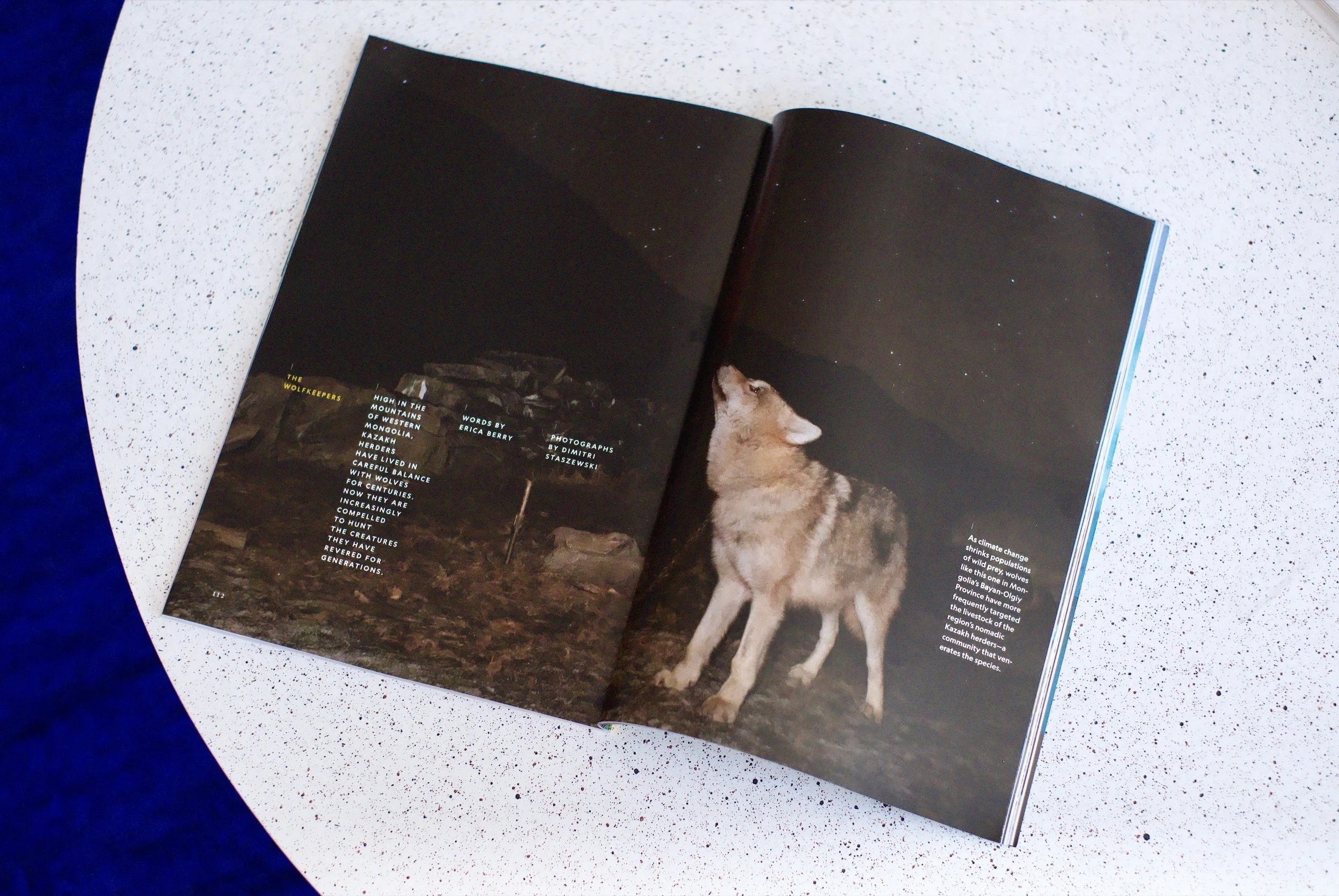
After ten years of dreaming and three years of intense work, I’m proud to share that the story I’ve been working on in Mongolia for the last three years has been published with National Geographic.
The magazine is available to purchase here directly through National Geographic. Unfortunately, the magazine is no longer available on newsstands. If you don’t have a subscription and want a physical copy, which I would personally recommend as the best presentation of the story, you’ll need to follow that link.
If you live in Austin and want a copy, I’ve ordered a bunch. Once they’re here, you can buy one directly from me.
Here’s a link to the digital version of the story, which you may or may not be able to see without a subscription—people have had mixed success.
* * *
I made my first trip to Bayan Ulgii, Mongolia’s western-most province in January of 2016. At the time, I was twenty-three. I had recently graduated from college, where I had focused on audio engineering. I was in Mongolia working on creating a free archive of traditional Mongolian music performed by nomadic herders (mongolmusicarchive.com).
Later that year, I made a second trip to Bayan Ulgii, where my translator and now close friend Nurbolat Len’s father, Len Mursali, shared a Kazakh myth with me:
Horse boasts, “I can see half the world at night.”
Wolf boasts, “I can see the whole world at night.”
Throughout that entire trip, Len and the herders we were staying with spoke about wolves in intense whispers. Even before understanding what they were saying through Nurbolat’s translations, I could intuit fear, respect, and reverence all melded together in their voices.
During that same trip, I saw several families raising wolf puppies.
I left with many more questions than answers, which started a ten-year journey of curiosity. If I’m being honest, it became this internal obsession. A fire I couldn't put out. I needed to understand why this community was raising wolves. To understand what it meant to see the world at night.
The publication of this story is the first step towards sharing the understanding I’ve come to over the last three years of research.
As another Kazakh myth goes:
Wolf says,
“Only those with the same spirit can see me.
Only those with a higher spirit can kill me.”
Over the last three years, the act of creating this new body of work has tested my spirit in so many ways. Twelve to eighteen-hour days on horseback in subfreezing temperatures. Month-long trips to Mongolia that would leave me 5 pounds lighter. Hours spent on grant applications that came up short. To get to the resounding yeses that made this publication possible, I had to navigate so much rejection.
There’s another reality where this same project took another ten years to complete. Either because I wasn’t able to prioritize the work in the same way, or because the elements in the story didn’t present themselves in front of me.
There was never a guarantee of seeing any wolves, let alone killing one. One herder, Seku, shared with me that in nineteen years of wolf hunting, he had never seen a wolf den—a crucial element in the story. Another herder, Mugalym, described hunting every day for a month without killing a wolf until the final day. While I spent several weeks following hunts over the course of three month-long trips to this community, setting aside a full month to follow hunts wasn't possible for me.
At points, my pursuit of this project felt genuinely delusional. I was spending thousands of dollars and months of my time with a nomadic family in Mongolia, working on a story nobody was asking me for. I was following a story because I felt that I had to understand what it means to see the world at night.
I say this all because I genuinely couldn’t have done this without the support of my community. Hearing the reinforcement that this work was worth it, that friends and people in my community also wanted to understand why this community is raising wolves, helped push me across the finish line.
In 2012, I ran a successful Kickstarter campaign to help purchase equipment as I studied abroad in Mongolia. I ended up expanding upon that work from 2015-2016 on a Fulbright-mtvU Fellowship. It was during that fellowship that I learned about the traditions that are now being shared in the storied pages of National Geographic.
There’s a direct line from that first trip to Mongolia and my Kickstarter to where I am today.
In many ways, I still feel like the same 20-year-old college student hustling to get the money together to buy camera equipment. The day the magazine arrived at my house, I had photographed a story for The New York Times in the morning, waited tables from 3 to 11:30 pm, met up with some friends to see a show, and then arrived at my doorstep close to 2 in the morning to see a box of magazines at my feet.
My life looks nothing like how I imagined it would when I was 20. In so many ways, I’m living far beyond anything I could have ever imagined.
This publication has validated years of work and a decade of dreaming. At the same time, it taught me that I don’t need institutional support to tell the stories I want to tell. That I can trust my own vision.
Whether you just learned of my work or have been following me since 2012, or even before then, thank you from the bottom of my heart for supporting me and my work.
You’re helping me live my dream, and I’m truly grateful.
This work is far from over. I am making a much more expansive book of this work. That will be a long process, but it has already started.
Sincerely,
Dimitri